


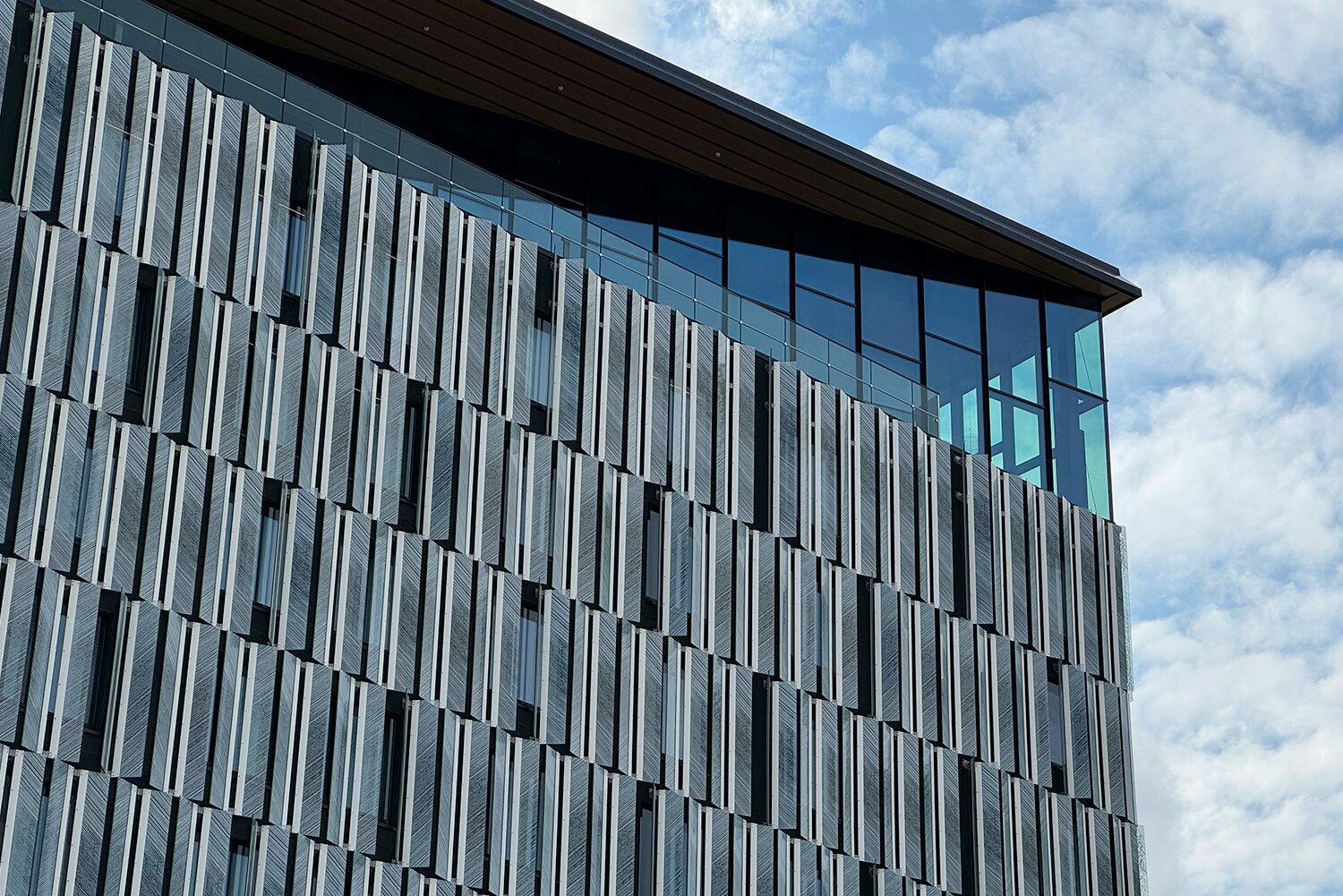
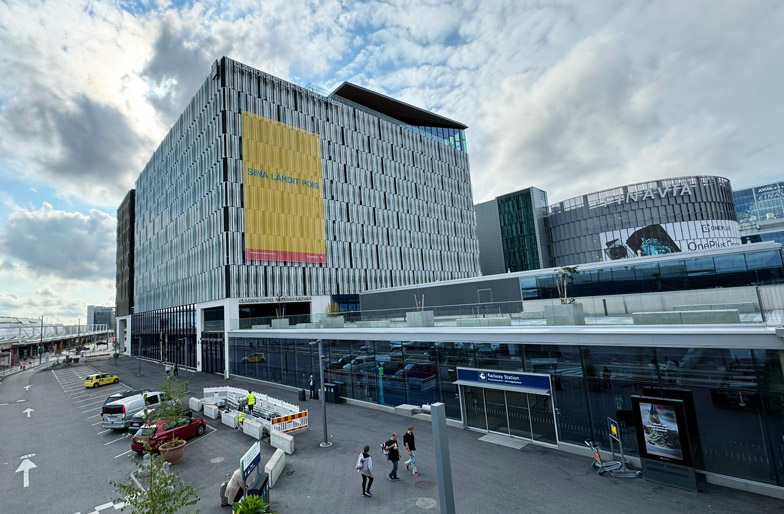
In June, the impressive Clarion Hotel Helsinki Airport opened next to Terminal 2 at Helsinki-Vantaa Airport. This is Finland’s largest hotel, accommodating over 500 guests and hosting events for up to 1,000 people.
The stylish hotel catches the eye even from an airplane window: its facade is fully glazed on three sides from the ground to the roof. The glass panels remain securely in place thanks to the seals we have designed and manufactured.
An exceptional sealing profile completes the facade
The hotel’s facade features 2,700 glass fins and 1,900 m² of glass walls. The facade combines glass and metal, requiring an exceptional sealing solution. We designed a special sealing profile that attaches the glass to the profile while also insulating it from the aluminum.
“There were several challenges in the facade’s structure, and we needed to find a production-friendly and easy-to-install solution,” explains our Sales Manager, Teemu Mäkiniemi. “Since the structure is separate from the facade, its wind load is unique: wind and other load factors, such as water, can enter the space between the structure and the wall.”
Structural durability is crucial for safety, as a busy road runs beneath the glass fins. The glass must remain securely in place under all conditions.
We designed an exceptionally deep U-profile for the structure. “It was at the limits of possibility to manufacture such a deep U-profile from rubber, but the final result worked exceptionally well,” Teemu describes.
Precise sealing ensures a durable and functional outcome
Precision is key in the construction process. The correct selection and installation of seals affect not only the durability of the structure but also its tightness and longevity. A thorough understanding of structural details and sealing needs ensures both functionality and aesthetic quality.
Dimensional accuracy and meticulous design are particularly important in sealing solutions. Smooth communication between different parties helps manage technical details and ensures that the result meets both technical requirements and customer expectations.
OT-Kumi’s use of construction industry innovations, such as 3D printing, also benefits seal development. This technology allows for testing and fine-tuning components before the production phase, speeding up the process and ensuring an optimal outcome.